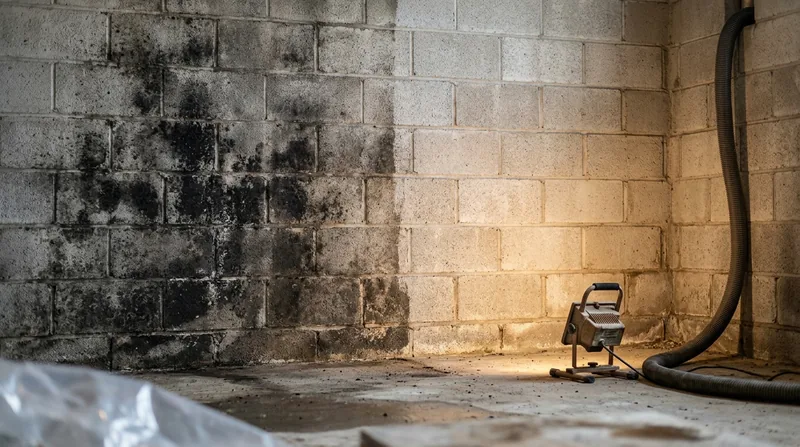




Basement Mold Remediation in Bowling Green: Fix the Moisture, Then the Mold
Bowling Green sits on karst limestone, and that geology decides how water moves under your house. Spring storms soak the clay soil, the water table climbs, and water pushes through block joints and old brick walls in the Hobson Grove bungalows and the foursquares near downtown. Basement Mold Remediation in Bowling Green starts with finding where that moisture comes from, not with spraying bleach on the studs. We remove the mold growth, treat the affected materials, and then correct the drainage or humidity problem that let it grow. Mold needs moisture and organic material, so killing the mold without fixing the water source just buys you a few months. We handle the full sequence: containment, treatment, and the below-grade fix that keeps the basement dry.
If you already see fuzzy growth on joists or smell that musty odor when you walk downstairs, start with a free basement inspection so we can trace the water path before anyone touches a surface.
Why Basement Mold Grows So Fast in Bowling Green Homes
The building stock here explains most of it. Pre-1950 brick and stone foundations near downtown have clay tile footing drains that are often crushed or root-filled, and 1950s-1980s brick ranches on the south and east sides have block walls with cold joints that seep. Add humid summers and freeze-thaw swings that open old masonry cracks, and you get a basement that stays damp from May through September.
- Water enters through hydrostatic pressure at the wall-floor joint and wicks up the block.
- White powder on the wall, called efflorescence, means moisture is moving through the masonry right now.
- A failed sump pump or a missing check valve lets the sump basin overflow during a storm.
- Clogged or crushed drain tile sends water back against the footing instead of away from it.
- Poor grading and short downspouts dump roof water within three feet of the foundation.
Any one of these keeps the basement humid enough for mold to return within one season, which is why we fix the water path first and treat the mold second.
Key info: In the older homes around Hobson Grove and the downtown grid, we routinely find mold on the lower two feet of framing and on stored cardboard, with no visible standing water. The moisture is coming through the wall, not from a leak you can see. The Kentucky Department of Housing, Buildings and Construction publishes contractor licensing information at dhbc.ky.gov if you want to verify credentials before hiring.
How We Run a Basement Mold Remediation in Bowling Green
We work in a fixed order because skipping steps is how mold comes back. First we find the moisture source with a pin meter and thermal camera, then we contain the work area, then we remove and treat, and only then do we correct the drainage or humidity. The last step is the one most homeowners skip, and it is the one that matters.
- We inspect the basement, the wall-floor joint, the sump basin, and the exterior grade to locate the water entry.
- We set up containment with poly sheeting and negative air pressure so spores do not spread to the rest of the house.
- We remove mold-damaged drywall, insulation, and wood that cannot be cleaned, and bag it for disposal.
- We treat structural surfaces with an antimicrobial and HEPA-vacuum the entire area.
- We correct the source: basement wall sealing, crack injection, drain tile repair, or a new sump pump as the diagnosis requires.
- We install or repair the vapor barrier and set up dehumidification so the basement stays below 60 percent relative humidity.
We finish with a musty smell diagnostic and a written moisture reading so you can verify the fix held after the next hard rain.
Key info: A 1960s ranch off Scottsville Road had mold across the lower block wall and a musty odor in the hallway upstairs. The cause was a crushed clay tile line at the footing and a sump pump that had burned out two summers earlier. We remediated the wall, replaced the sump pump with a battery backup unit, and the basement stayed dry through the next spring storm cycle.
Remediation Methods We Use and When Each One Fits
Not every mold job needs the same approach. A small patch on a wall that seeped once is a different job from a basement that has been wet for years. The table below shows how we match the method to the condition we find on site.
| Approach | Description | Best for |
|---|---|---|
| Surface treatment and HEPA cleaning | Antimicrobial application, HEPA vacuuming, and wipe-down of structural surfaces. | Light growth on block or poured walls with a single known moisture event. |
| Containment and material removal | Poly containment, negative air, removal of mold-damaged drywall, insulation, and wood. | Growth on finished walls, framing, or stored contents after long-term dampness. |
| Moisture source correction | Crack injection, wall sealing, drain tile repair, or sump pump replacement as needed. | Recurring mold tied to hydrostatic pressure, a failed sump, or a clogged footing drain. |
| Humidity control | Vapor barrier repair, sealed sump lid, and dehumidification sized to the basement volume. | Summer humidity in basements with no active leak but persistent musty odor. |
Basement Mold Remediation Cost in Bowling Green: What to Expect
Most basement mold jobs in Bowling Green start around $1,500, and that figure covers containment, treatment, and disposal for a contained area. The price climbs when the mold has spread across a finished basement, when framing has to be removed, or when the moisture fix requires drain tile work or a sump pump replacement. A small patch on an unfinished block wall is at the low end. A finished basement with wet carpet, moldy studs, and a failed footing drain lands at the high end.
The variables that move the number are the square footage affected, whether materials are finished or bare, how many moisture sources we find, and whether the repair needs excavation or can be solved from the inside. We do not quote remediation separately from the moisture fix, because a mold price without the water correction is a temporary number. Get two or three estimates and ask each contractor what they will do about the water source.
Our pricing page breaks down how we build these estimates, and we will walk you through the line items on site.
Basement Mold Remediation Near Me: How to Pick a Contractor Near Bowling Green
Mold remediation and waterproofing are two different trades, and you want a contractor who does both or who works with a waterproofing specialist. A remediation-only company will clean the mold and leave the water problem for someone else, and the mold returns. Ask direct questions before you sign anything, and check the answers against the Kentucky licensing database.
- Confirm the contractor is licensed and insured and ask for a certificate of insurance before work begins.
- Get at least three written estimates that separate remediation from the moisture repair.
- Ask for local references from Bowling Green or Warren County and call them.
- Ask whether the work needs a permit from the local building department, since structural repair and drainage changes often do.
- Ask how they will verify the basement is dry after the job, and get that in writing.
If a contractor cannot explain where the water is coming from, keep looking. You can reach us through our contact page to schedule an inspection and get a straight answer on what your basement needs.
Basement Mold Remediation in Bowling Green: Pricing Guide
| Service | Price | Details |
|---|---|---|
| Surface treatment and HEPA cleaning | Starting at $1,500 | Covers containment, antimicrobial treatment, and HEPA vacuuming for a contained area; affected square footage moves the price. |
| Containment and material removal | Starting at $2,400 | Includes poly containment, negative air, and disposal of mold-damaged drywall and framing; finished basements push this higher. |
| Remediation plus moisture source repair | Starting at $3,200 | Adds crack injection, wall sealing, or sump work; excavation or drain tile replacement moves the number up. |
| Complex or large-scale job | On estimate | Full finished basements with multiple moisture sources need an on-site inspection before any number is given. |
| Travel | Included | In Bowling Green and surrounding Warren County areas, no separate call-out or mileage fee. |
| Estimate | Free | Response within 24 hours at (270) 721-6011, no obligation to book. |
Indicative pricing, the exact cost depends on square footage, finish, and site access. Free personalized estimate within 24h at (270) 721-6011.


