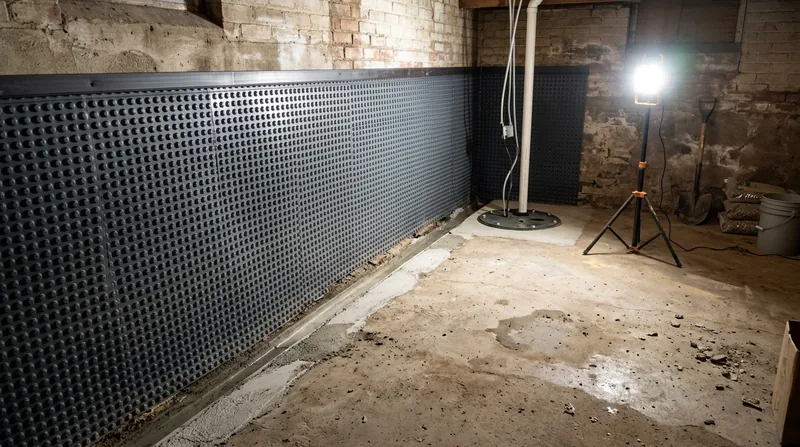




Bowling Green sits on karst limestone, and that geology decides how water moves under your house. Spring storms soak the clay cap, the water table rises, and it pushes against old brick and block foundations in Hobson Grove and the downtown blocks, where full basements and clay tile drains are still doing their 1930s job. Out on the south and east sides, 1950s to 1980s ranches and split-levels leak at the floor joint and the block mortar lines after every heavy rain. If you are dealing with a wet basement, Basement Waterproofing in Bowling Green means tracing the actual water path before anyone quotes a fix. We start with a free basement inspection and tell you straight whether you need a full interior system or a single crack sealed.
Why Water Finds Its Way Into Bowling Green Basements
The dominant failure here is hydrostatic pressure at the footing after spring rain, not a single bad crack. Clay soil over limestone holds water for days, then releases it unevenly toward the lowest corner of the wall. Freeze-thaw swings in January and February open old masonry joints, and the Barren River rising after long rains backs up footing drains that were undersized when they were installed.
- Water seeps through the floor-wall joint because the original clay tile drain is crushed or silted shut.
- Block walls wick moisture upward and show white efflorescence as salts push out of the mortar.
- Older stone and brick foundations in Hobson Grove crack where freeze-thaw cycles have widened the mortar.
- Grading that slopes back toward the house sends downspout water straight into the foundation zone.
- Window wells on split-levels fill and overflow during flash flooding on the south side streets.
Each of these reads differently in the field, and the fix that works on one wall will fail on the next if the water source is misread.
Key info: A home near Lost River in the 42101 zip can have a spring-fed water table that never fully drops, while a ranch in Plum Springs dries out by June. Same county, two different systems, and the inspection decides which one you get.
Permits for work that alters drainage or the sanitary connection of a sump discharge vary by jurisdiction, so verify the current requirements with the City of Bowling Green building department before work starts.
How We Waterproof a Bowling Green Basement, Step by Step
We work from the water path backward. That means finding where the water enters, how much pressure is behind it, and what the existing drain tile is actually doing before we cut any concrete. On most jobs the answer is an interior perimeter drain tied to a sump basin, not an exterior excavation that tears up mature landscaping.
- We inspect the basement, the exterior grading, and the downspout discharge to map how storm runoff reaches the foundation.
- We test the existing footing drain where accessible and check the sump basin and check valve for capacity and condition.
- We cut a channel along the interior perimeter, install drain tile on a gravel bed, and lead it to a new sump basin.
- We seal the floor joint and wall cracks with epoxy or polyurethane injection depending on whether the crack is structural or active seepage.
- We install the sump pump and discharge line, add a battery backup if the home loses power during storms, and cover the wall with a vapor barrier.
- We run water through the system and confirm it moves to the discharge point before we call the job done.
If the wall is bowing rather than just damp, we stop and bring in bowing wall repair with carbon fiber straps or anchors before any drainage work.
Key info: A 1958 brick ranch off Scottsville Road had water crossing the floor every March. The footing drain was collapsed clay tile, so we cut an interior perimeter drain, set a new sump basin at the low corner, and tied the discharge to a line that runs to the street grade. The floor has stayed dry through two spring storm seasons.
Interior Drain Tile vs Exterior Waterproofing: Which Fits Your Foundation
Bowling Green homeowners ask this constantly, and the honest answer depends on the wall type, the water source, and how much the exterior is worth disturbing. A poured wall with active seepage at the joint usually takes an interior system at a lower cost and with no excavation. A stone foundation that is failing from the outside, or a wall that has already bowed, may need the exterior side opened up.
| Approach | Description | Best for |
|---|---|---|
| Interior perimeter drain | Drain tile cut along the inside footing, led to a sump basin and pump. | Block and poured walls with hydrostatic pressure at the floor joint. |
| Exterior membrane and drain | Excavation to the footing, waterproof membrane, dimple board, and new footing drain. | Stone foundations and walls with exterior-side deterioration. |
| Crack injection | Epoxy or polyurethane injected through ports to seal a single crack. | Isolated non-structural cracks with no widespread pressure. |
| Wall sealing and vapor barrier | Parging, sealer, and a vapor barrier over damp masonry. | Damp walls and musty basement smell without standing water. |
| Sump pump and battery backup | Primary pump, check valve, discharge line, and battery backup. | Any system that needs to keep running when the power drops. |
The table is a starting point, not a diagnosis. We confirm the right approach on site, and we say plainly when simple crack sealing is enough.
Basement Waterproofing Cost in Bowling Green: What to Expect
Most full interior systems in Bowling Green start around $2,500 and climb from there based on linear footage, wall condition, and pump capacity. A single injected crack sits at the low end, while a stone foundation that needs exterior excavation and a new footing drain runs well above that range. The variables that move the number are the length of wall to be drained, whether the existing drain tile can be reused, the sump pump and backup you choose, and access for equipment.
Get two or three written estimates and compare what is actually included, not just the bottom line. A quote that skips the vapor barrier or the check valve is not the same job as one that includes them. Our full breakdown lives on the pricing page, and the on-site inspection confirms which line items apply to your basement.
Hiring a Basement Waterproofing Contractor Near Me in Bowling Green
Ask for the license and insurance certificate before anyone walks the basement, and confirm the policy covers below-grade work. Check references from jobs in Bowling Green and the surrounding towns, ideally homes of similar age and foundation type. Get the scope in writing, including the sump pump model, the vapor barrier spec, and what happens if the system does not perform. Confirm who pulls any permit required for drainage or discharge work with the local building department, and check HOA rules before exterior excavation changes the grade or the landscaping.
Reach us through the contact page or call (270) 721-6011 to set up the inspection.
Basement Waterproofing in Bowling Green: Pricing Guide
| Service | Price | Details |
|---|---|---|
| Single crack injection | Starting at $2,500 | Epoxy or polyurethane injection with ports, plus sealing of the floor joint at the entry point. |
| Interior perimeter drain system | Starting at $3,800 | Drain tile along the footing, sump basin, primary pump, and vapor barrier over the damp wall. |
| Exterior waterproofing | On estimate | Excavation depth, footing drain condition, and landscaping access decide the scope before a number is given. |
| Sump pump and battery backup | Starting at $1,200 | Primary pump, check valve, discharge line, and battery backup sized to the basin and storm load. |
| Travel | Included | In Bowling Green and surrounding areas, no separate call-out or mileage fee. |
| Estimate | Free | Response within 24h at (270) 721-6011, no obligation to book. |
Indicative pricing, the exact cost depends on square footage, finish, and site access. Free personalized estimate within 24h at (270) 721-6011.


