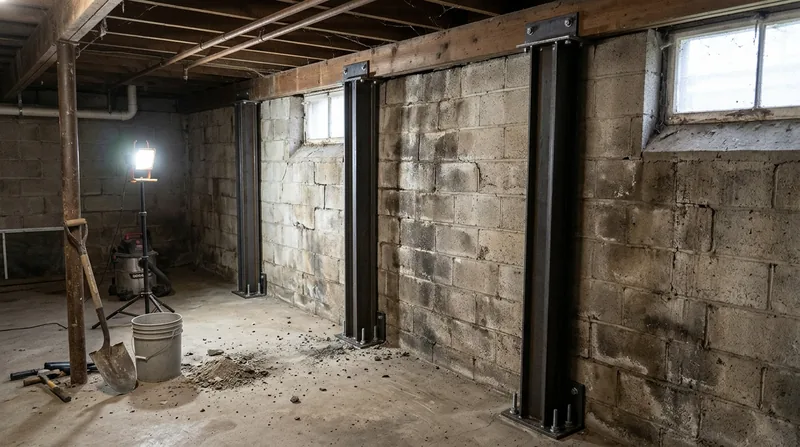




Bowling Green sits on karst limestone, and that geology shapes how a foundation wall moves. The clay soil over that limestone holds spring rain, then drains unevenly, and the pressure it puts on an older block wall is relentless. If you have noticed a wall leaning inward, a horizontal crack widening at mid-height, or doors and windows that no longer close square, you are looking at Bowing Wall Repair in Bowling Green territory, not a cosmetic fix. The 1910s-1940s bungalows and foursquares near Hobson Grove and downtown often carry full basements under brick or stone walls, and those walls were never built for the hydrostatic pressure a wet Kentucky winter delivers. We stabilize leaning and bowing walls with carbon fiber straps, steel I-beams, or wall anchors, matched to how far the wall has moved and how much wet clay is pushing behind it. Call (270) 721-6011 for a free basement inspection before the next rain season opens the crack further. For the full picture of how wall stabilization fits with water control, start with our basement waterproofing service.
Why Bowing Walls Are a Bowling Green Problem, Not a Cosmetic One
A bowing wall is a structural symptom, and in Bowling Green the cause is almost always water. Clay over limestone holds spring rain against the foundation, the water table rises after long storms, and the Barren River backs up the low ground. That pressure has to go somewhere, and on a 1950s-1980s brick ranch on the south or east side, it goes into the block wall. The wall bows inward at mid-height, a horizontal crack opens, and the top of the wall starts to rotate. Left alone, the movement accelerates with every freeze-thaw cycle.
- You see a horizontal crack running the length of a block wall, usually at the middle course.
- The wall leans inward at the top, and the floor joists above it start to pull away from the plate.
- Doors and windows on the main floor stick or rack out of square as the wall pushes the frame.
- White efflorescence blooms along the wall base, a sign water is moving through the masonry.
- You find a bow of an inch or more when you hold a straightedge against the wall.
Any one of these means the wall needs to be evaluated before the next wet season, because the pressure behind it does not stop on its own.
Key info: On the older brick and stone basements near downtown and Hobson Grove, we often find a bowed wall paired with failed clay tile drains. Stabilizing the wall without restoring drainage leaves the same pressure pushing on the new reinforcement. The two fixes belong together.
For background on foundation performance and structural repair standards, the City of Bowling Green building department is the authority on what permits apply to structural foundation work in this jurisdiction.
How We Stabilize a Bowing Wall in Bowling Green
We start by measuring the movement, not guessing at it. A plumb line and a straightedge tell us how far the wall has bowed and whether the top is rotating. We check the soil side for the water source, look at the drain tile and footing drain condition, and read the crack pattern. From there we match the repair to the severity: a strap for a wall that has moved less than two inches, an anchor or beam for one that has gone further.
- We inspect the wall, measure the bow, and identify whether hydrostatic pressure or a failed drain is driving the movement.
- We excavate or work from the interior as the method requires, and we address the water source before we reinforce.
- We install carbon fiber straps, steel I-beams, or wall anchors at the spacing the wall's condition calls for.
- We seal cracks and tie the reinforcement into the footing and the floor system above.
- We verify the wall is stable and give you a written record of the movement so future inspections have a baseline.
The goal is to stop the movement and hold the wall where it is, not to pretend it never bowed.
Key info: A ranch off Plano Road had a block wall bowed two inches after a wet March. The clay tile drain at the footing had collapsed, so water sat against the wall all spring. We restored drainage and installed carbon fiber straps on 48-inch centers. The wall has not moved since, and the homeowner has a baseline measurement to check against.
If the inspection shows the real problem is water management rather than structural movement, an interior drain tile system is often the better answer than exterior excavation, and we will tell you so plainly.
Bowing Wall Repair Methods We Use
The method follows the severity of the movement and the pressure behind the wall. A wall that has bowed half an inch does not need the same repair as one that has rotated three inches at the top. We match the approach to the wall, and we explain why we chose it.
| Approach | Description | Best for |
|---|---|---|
| Carbon fiber straps | High-strength straps bonded vertically to the interior wall face and anchored to the footing and floor system. | Block walls bowed less than two inches with no top rotation. |
| Steel I-beams | Vertical steel beams set against the wall and tied into the footing and the floor above. | Walls with larger movement or where the top is rotating inward. |
| Wall anchors | Earth anchors set outside the wall, connected through the wall to interior plates that pull it back over time. | Walls that can be straightened rather than only held in place. |
| Crack sealing and drainage repair | Epoxy or polyurethane injection of the crack, plus repair of the drain tile and footing drain. | Walls with minor movement where water is the main driver. |
| Parging and wall sealing | Repair of the exterior face and sealing of the wall to shed water before it reaches the masonry. | Walls that are stable but seeping after heavy rain. |
We do not sell a strap to a wall that only needs a crack sealed, and we do not seal a crack on a wall that is actively bowing.
Bowing Wall Repair Cost in Bowling Green: What to Expect
Pricing for bowing wall repair starts from $600 for a straightforward crack and drainage correction, and rises from there with the method and the length of wall involved. Carbon fiber straps on a short wall run are at the low end. Steel beams or wall anchors on a full basement wall that has rotated are at the high end, because the work is more involved and the engineering is more specific. Get two or three estimates and compare what each one actually includes, especially whether drainage is addressed.
The factors that move the number are the length of the bowed wall, how far it has moved, whether the top is rotating, whether the drain tile is failed, and how much excavation the method requires. Access matters too, and a basement under a downtown bungalow can be tighter to work in than a ranch on a graded lot. A quote that does not mention the water source is a quote for half the problem. See our pricing overview for the full range before you commit.
Bowing Wall Repair Near Me: How to Choose a Contractor Near Bowling Green
The contractor you hire should be able to explain why your wall moved, not just sell you a repair. Ask for the license and insurance certificate, and confirm the coverage is current. Get more than one estimate and compare the method each one proposes. Check references from basements like yours, particularly older block or stone walls. Structural foundation repair commonly requires a permit in this jurisdiction, so ask who pulls it, and verify the requirements with the local building department, since rules vary and must be confirmed.
If your home is in a subdivision with an HOA, check the rules before any exterior excavation or anchor installation, because some associations restrict what can be done on the lot. A contractor who has worked in Bowling Green will know the local soil and the older drain systems and will not be surprised by what is behind the wall. Reach out through our contact page to schedule an inspection and get a written scope before any work begins.
When Bowing Wall Repair Is the Right Call, and When It Is Not
Not every crack means the wall is bowing, and not every bow needs anchors. If the wall has moved less than a quarter inch and the crack is vertical and stable, sealing the crack and correcting the drainage may be all that is needed. If the wall has a horizontal crack at mid-height and a measurable bow, stabilization is the right call. We tell you which one you have after we measure it. If the movement is severe, we will say so and explain what the repair can and cannot do.
Our foundation crack repair service handles the sealing side when that is the whole job, and our free basement inspection is where every bowing wall conversation should start.
Bowing Wall Repair in Bowling Green: Pricing Guide
| Service | Price | Details |
|---|---|---|
| Crack sealing and drainage correction | Starting at $600 | Covers injection of a stable crack and correction of the water source driving it, priced by crack length and access. |
| Carbon fiber strap installation | Starting at $1,200 | Includes straps bonded to the wall and anchored top and bottom, priced by wall length and strap spacing. |
| Steel I-beam or wall anchor system | Starting at $2,800 | For walls with larger movement or top rotation, priced by beam count, excavation, and engineering required. |
| Full wall stabilization with drain repair | On estimate | Needs an on-site look because the scope depends on drain condition, wall length, and how far the wall has moved. |
| Travel | Included | In Bowling Green and surrounding areas, no separate call-out or mileage fee. |
| Estimate | Free | Response within 24h at (270) 721-6011, no obligation to book. |
Indicative pricing, the exact cost depends on square footage, finish, and site access. Free personalized estimate within 24h at (270) 721-6011.


