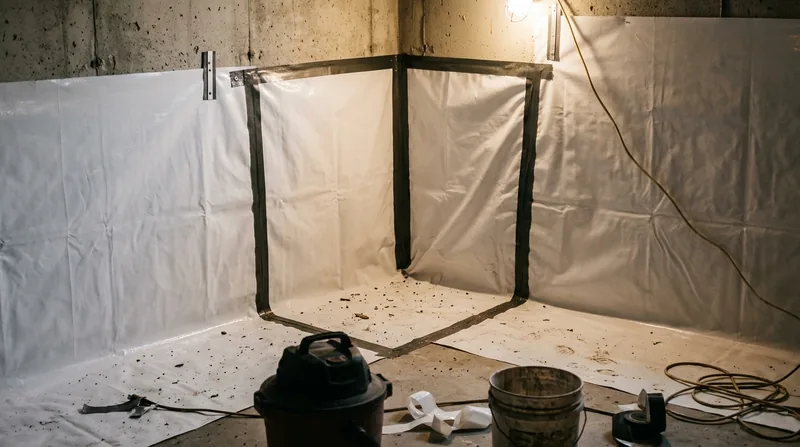




Vapor Barrier Installation in Bowling Green: Stop the Ground Moisture Before It Reaches Your Walls
Vapor Barrier Installation in Bowling Green is the below-grade job that stops invisible ground moisture from pushing through your basement slab and foundation walls. This city sits on karst limestone, and the clay soil above it holds spring rain like a sponge before draining unevenly into old brick and block foundations. In the bungalows and foursquares near Hobson Grove and downtown, we routinely find damp slab edges, white efflorescence on the lower block courses, and a musty smell that comes back every June. A heavy-duty vapor barrier, sealed at the seams and taped at the terminations, cuts that vapor drive at the source. If you are also dealing with active seepage, start with our basement waterproofing service and we will tell you honestly which fix your basement actually needs.
Why Bowling Green Basements Sweat: Karst, Clay, and the Spring Water Table
Bowling Green sits on limestone with underground streams and springs such as Lost River running beneath the city, and the clay layer above that rock traps water against foundation walls instead of letting it drain away. After a long spring rain, the Barren River rises and the water table lifts with it. That is when vapor drive peaks in the older block and poured basements on the south and east sides of town. The moisture comes through the concrete itself, not just through cracks, so painting the wall does nothing.
- Clay soil over limestone holds water against the footing and keeps the lower wall permanently damp.
- Freeze-thaw cycles in January and February open hairline cracks that let vapor and liquid water through.
- Older clay tile drains under 1910s-1940s homes clog and stop moving water away from the footing.
- Efflorescence on the lower block courses is the visible sign that moisture is migrating through the masonry.
- A musty basement smell in summer is ground vapor condensing on cool wall and slab surfaces.
If you see any of these signs, the vapor barrier is the first layer of defense, and it works best when paired with proper drainage.
Key info: In the brick foursquares near Hobson Grove, we often find the slab edge wicking water all summer while the upper wall stays dry. That pattern points to vapor drive from the soil, not a leaking wall, and a sealed vapor barrier is the correct fix.
Local code questions about below-grade work go through the City of Bowling Green building department, and you can verify contractor licensing through the Kentucky Department of Housing, Buildings and Construction.
How We Install a Vapor Barrier in a Bowling Green Basement
We start by walking the basement and grading the actual problem: slab vapor drive, wall seepage, or a high water table pushing through the cove joint. From there we map the wall and floor surfaces, check the sump basin and discharge line, and confirm whether the perimeter drain is moving water or has failed. The install is sequenced so the barrier seals tight against every penetration and never traps water behind it.
- We inspect the walls and slab for active leaks, efflorescence, and failed parging before any sheet goes up.
- We clean and prep the surface so the adhesive and termination tape bond to concrete, not to dust.
- We cut and fit heavy-duty barrier sheets to the wall height and slab dimensions, overlapping seams by the manufacturer's spec.
- We seal every seam and tape all terminations at the cove joint, penetrations, and sump basin lip.
- We integrate the barrier with the sump basin and check valve so any water that reaches the drain exits the discharge line.
- We leave the basement clean and walk you through what the barrier covers and what it does not.
Every install ends with a visual check of the seams and terminations, because a vapor barrier is only as good as its taped edges.
Key info: On a 1950s brick ranch off Scottsville Road, the slab edge read damp year-round while the wall above stayed dry. We sealed the cove joint, ran the barrier up the wall, and tied it into the existing sump basin. Two spring storms later, the floor was still dry.
If the inspection shows the perimeter drain is clogged or crushed, the barrier alone will not solve it, and we will point you to drain tile repair and replacement before we quote the barrier.
Vapor Barrier Approaches We Use in Bowling Green Homes
Not every basement needs the same barrier system. A 1920s stone foundation in the downtown grid behaves differently from a 1970s poured wall on the south side, and the right approach depends on whether the moisture is vapor, liquid seepage, or both. Here is how we match the method to the building.
| Approach | Description | Best for |
|---|---|---|
| Wall and slab vapor barrier | Heavy-duty sheet sealed at seams and taped at the cove joint, covering wall and floor surfaces. | Damp slab edges and musty basements with no active liquid seepage. |
| Barrier with dimple board | Drainage mat behind the barrier that channels any wall water down to the perimeter drain. | Block walls with intermittent seepage after heavy spring storms. |
| Sump-integrated barrier | Barrier tied into the sump basin lip with a sealed termination and checked discharge line. | Basements with an existing sump pump or a high water table near Lost River. |
| Partial barrier on lower wall | Barrier run from the cove joint up to a fixed height where the upper wall stays dry. | Finished basements where only the lower block courses show efflorescence. |
| Barrier plus wall sealing | Crack injection and wall sealing first, then the barrier over a dry, prepped surface. | Walls with visible cracks that also read damp across the surface. |
Vapor Barrier Installation Cost in Bowling Green: What to Expect
Vapor barrier pricing starts at From $3/sq ft for a standard wall and slab install with sealed seams and taped terminations. Most Bowling Green basements land in a predictable range once we measure the wall height, slab area, and number of penetrations. The square footage is only the starting point, though, because the prep work and the integration details drive the final number.
- Wall height and slab area set the base square footage, and taller walls mean more material and more seam tape.
- Surface prep matters: failing parging, efflorescence, and dust all have to be removed before the barrier bonds.
- Sump integration adds labor for the basin lip seal and discharge line check.
- Dimple board or drainage mat behind the barrier pushes the price up but is often the right call on damp block walls.
- Access matters in older downtown homes where the basement stairs are narrow and material has to be carried in by hand.
Getting two or three written estimates is the smart move, because a quote that skips prep or skips the sump integration is not the same job. Our full pricing overview lays out the ranges so you can compare apples to apples.
Vapor Barrier Installation Near Me: How to Vet a Contractor Near Bowling Green
When you search for vapor barrier installation near me, the results all look similar, so the decision comes down to credentials and how the contractor scopes the job. A dedicated basement waterproofing specialist will inspect the walls, slab, and sump before quoting, and will tell you when a simple wall seal is enough instead of selling a full barrier. General foundation firms and plumbers do good work, but below-grade moisture control is its own trade.
- Confirm the contractor is licensed and insured, and ask for a certificate of insurance before work starts.
- Get two or three written estimates that itemize prep, material, seam sealing, and sump integration.
- Ask for local references from basements similar to yours, especially older block or stone foundations.
- Ask who pulls any permit required for structural or drainage work, and confirm the local building department's rules.
- Check HOA requirements for exterior discharge routing before the crew arrives.
If a contractor will not put the scope in writing or cannot explain how the barrier ties into your sump, keep looking. You can reach us through our contact page to schedule an inspection and get a straight answer on what your basement needs.
Vapor Barrier Installation in Bowling Green: Pricing Guide
| Service | Price | Details |
|---|---|---|
| Wall and slab vapor barrier | Starting at $3/sq ft | Includes surface prep, heavy-duty sheet, sealed seams, and taped terminations at the cove joint. |
| Barrier with dimple board | Starting at $4.50/sq ft | Adds drainage mat behind the barrier to channel wall water to the perimeter drain. |
| Sump-integrated barrier | Starting at $5/sq ft | Includes basin lip seal, discharge line check, and check valve inspection on the existing pump. |
| Partial lower-wall barrier | Starting at $3.50/sq ft | Barrier from cove joint to a fixed height where upper wall stays dry; priced by linear wall foot. |
| Complex or large-scale job | On estimate | Older stone foundations, multiple rooms, or failing parging need an on-site look before pricing. |
| Travel | Included | In Bowling Green and surrounding areas, no separate call-out or mileage fee. |
| Estimate | Free | Response within 24h at (270) 721-6011, no obligation to book. |
Indicative pricing, the exact cost depends on square footage, finish, and site access. Free personalized estimate within 24h at (270) 721-6011.


