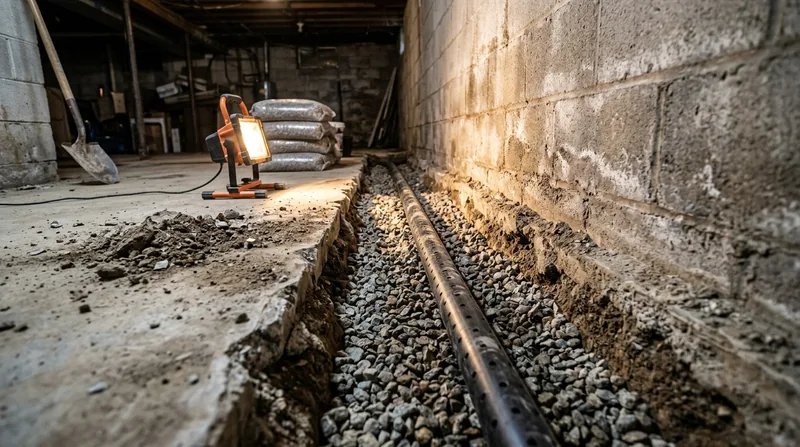




Bowling Green sits on karst limestone, and that geology decides how water behaves under your house. The clay soil over that limestone holds spring rain like a sponge, then releases it unevenly toward the lowest point it can find, which is usually the footing under your basement slab. That is why so many full basements in the older bungalows and foursquares near Hobson Grove and downtown stay damp even when the walls look fine from the outside. A properly installed Interior Drain Tile System in Bowling Green captures that water at the footing before it reaches your floor and routes it to a sump basin, where a pump sends it out and away. We install these systems year-round because the work happens under the slab, not out in the weather. If you are still weighing options, start with our basement waterproofing overview and then we can talk specifics.
Why Interior Drain Tile Matters So Much in Bowling Green's Clay and Limestone
The dominant failure mode here is hydrostatic pressure from clay soil that saturates during spring storms and then drains slowly. Older block and stone foundations in the downtown and Hobson Grove neighborhoods often still have clay tile drains that have silted shut or cracked, so water backs up at the footing and finds the wall joints instead. On the south and east sides, the 1950s to 1980s brick ranches and split-levels have poured or block walls that seep at the cove joint after long rains. An interior perimeter drain relieves that pressure at the source.
- We relieve hydrostatic pressure at the footing instead of letting it push against the wall.
- We intercept water before it reaches the slab and channel it to a sump basin.
- We replace failed clay tile drains that have collapsed or filled with silt.
- We install in any season, so spring flooding does not have to wait for a dry window.
The result is a basement that stays dry through the freeze-thaw swings and the heavy spring storms that push the Barren River up after long rains.
Key info: A homeowner in the older streets near downtown called us after every spring storm left an inch of water in the low corner of a 1920s brick basement. The original clay tile drain had collapsed under the slab. We installed an interior perimeter drain and a new sump basin, and the floor has stayed dry through two spring seasons since.
For the official word on permits and inspection requirements, the City of Bowling Green website is the place to verify local rules before any work begins.
How We Install an Interior Drain Tile System in Bowling Green
We start by inspecting the basement and the exterior grade, because the water has to be coming from somewhere. We look for efflorescence, wall seepage, and the low corners where water pools. Then we break out a perimeter channel along the inside of the footing, install perforated pipe in washed gravel, and tie it into a sump basin. The discharge line runs to a point where it can drain away from the foundation, and we check the check valve so water does not flow back.
- We inspect the basement, the footing, and the exterior grading to find the water path.
- We cut a perimeter channel along the inside of the footing and remove the old failed drain if present.
- We set perforated drain tile in washed gravel and slope it toward the sump basin.
- We install the sump basin and pump, with a check valve on the discharge line.
- We restore the slab and test the system with water before we leave.
Every step is done with the basement's actual water path in mind, not a one-size-fits-all trench.
Key info: In a 1960s split-level off Scottsville Road, the water was entering at the cove joint on the uphill side. We ran the interior drain along that wall and tied it to a new sump basin, and the discharge line was extended to the daylight slope behind the house. The homeowner had been mopping after every rain for three years. If your situation sounds similar, our sump pump installation page explains how the pump side of the system works.
Interior Drain Tile Methods We Use in Bowling Green
The right method depends on the wall type, the footing depth, and how much water the soil is holding. We choose based on what the basement is actually doing, not on what is easiest to sell. Here is how the main approaches compare.
| Approach | Description | Best for |
|---|---|---|
| Interior perimeter drain | Perforated pipe in gravel along the inside of the footing, tied to a sump basin. | Clay soil that holds spring water under the slab. |
| Drain tile replacement | Remove collapsed or silted clay tile and install new perforated pipe. | Older homes with failed original drains. |
| Sump basin and pump | Basin set below the slab with a pump and check valve on the discharge line. | Any interior drain system that needs to move water out. |
| Exterior footing drain | Drain installed outside the footing, with membrane and gravel. | When the wall itself is failing and excavation is the better answer. |
We will tell you plainly when simple crack sealing is enough and when the real problem is pressure under the floor. For the exterior comparison, see our exterior basement waterproofing page.
Interior Drain Tile System Cost in Bowling Green: What to Expect
Most interior drain tile work in Bowling Green starts around $50 per linear foot, and that figure moves with the length of the run, the wall type, and how much slab has to be opened. A short run along one wet wall costs less than a full perimeter, and a basement with a failed clay tile drain underneath adds removal time. Access matters too: a narrow stairwell and a finished basement slow the work down. We give you a written scope before we start, and we do not add line items later.
Get two or three estimates and compare the scope, not just the number. A low bid that skips the sump basin or the gravel is not the same job. Our pricing page lays out the full range so you can see where your basement falls.
Hiring a Waterproofing Contractor Near Bowling Green: What to Check
Ask for the license and insurance certificate before anyone touches your slab. Confirm the contractor carries general liability and workers compensation, and get the certificate sent to you, not just a verbal yes. Ask for two or three recent references in Bowling Green or the surrounding towns, and call them. Ask who pulls the permit if the work touches drainage or the sump discharge connection, because rules vary by jurisdiction and the local building department has the final word. For a free inspection and a straight answer, contact us.
Interior Drain Tile System Near Me: What Bowling Green Homeowners Should Know
If you are searching for an interior drain tile system near me in Bowling Green, the key is to match the system to the water path, not to a generic package. Homes in Smiths Grove, Plum Springs, and Woodburn sit on the same clay over limestone, and the same rules apply. We inspect first, explain what we find, and quote the work that actually solves the problem. Call (270) 721-6011 and we will set up a free basement inspection.
Interior Drain Tile System in Bowling Green: Pricing Guide
| Service | Price | Details |
|---|---|---|
| Interior perimeter drain, single wall | Starting at $50/linear ft | Includes channel cut, perforated pipe, washed gravel, and slab restoration along one wall. |
| Full perimeter interior drain | Starting at $50/linear ft | Covers all four walls, with sump basin tie-in and discharge line to grade. |
| Drain tile replacement with failed clay tile | Starting at $65/linear ft | Adds removal of collapsed or silted clay tile and disposal before new pipe goes in. |
| Sump basin and pump add-on | Starting at $850 | Basin, pump, check valve, and discharge line, priced with the drain run. |
| Complex or large-scale job | On estimate | Finished basements, deep footings, or multiple water entry points need an on-site look first. |
| Estimate | Free | Response within 24h at (270) 721-6011, no obligation to book. |
Indicative pricing, the exact cost depends on square footage, finish, and site access. Free personalized estimate within 24h at (270) 721-6011.


